

The Iran War fuel shock is showing up in NOTAMs
5/17/2026
The aviation fuel crisis is usually discussed through oil prices, refinery capacity, tanker routes, and airline schedule cuts.
That is the macro view. The operational view is quieter, but often more useful: which airports are telling pilots and dispatchers that fuel service is restricted or unavailable?
Using structured NOTAM data from Notamify Affected Elements V2, we analyzed fuel-related NOTAM affected elements published between 24 April and 17 May 2026. The result is a clear signal: the Iran War fuel shock is visible at airport level as fuel service disruption, especially outside the largest hubs.
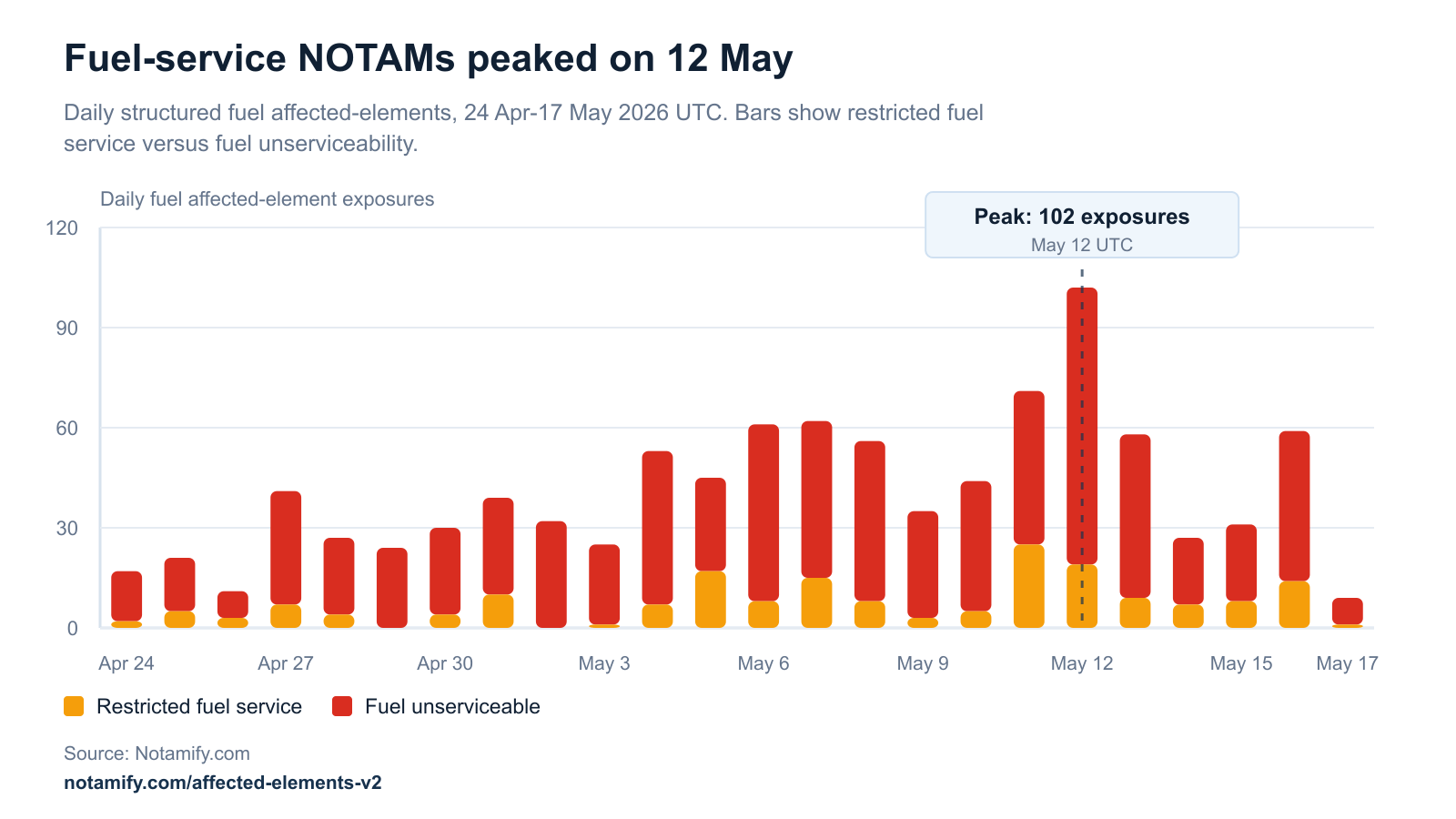
The timeline does not show a smooth, gradual rise. It shows waves of fuel-service disruption, with the largest daily spike on 12 May 2026, when structured affected elements captured 102 fuel-service exposures in one UTC day.
What we measured
The analysis used structured affected elements, not keyword matching. We focused on fuel-service restrictions and unserviceability at airport level, then grouped the resulting signal by airport and fuel context where the NOTAM made that context clear.
This produced:
- 980 fuel affected-element exposures
- 643 source NOTAM rows
- 387 distinct airport / ICAO codes
- 154 jet-fuel exposures
- 81.4% of fuel exposures classified as unserviceable
That distinction matters. A simple text search for "fuel" would find notices. Affected Elements V2 tells us whether the fuel service is unavailable or restricted, which fuel type is affected when the notice says so, and which airport the NOTAM applies to.
This is not Q-code aggregation. Q-codes are useful metadata, but they do not carry enough operational meaning on their own for this kind of airport-service analysis.
The main finding: this is an outage signal
The dominant operational signal is not "fuel mentioned in a NOTAM." It is fuel service being unavailable.
Of the 980 structured fuel exposures, 798 were unserviceable. Only 182 were classified as restricted.
That matters for operations. A restriction may mean fuel is available under conditions: a limit, schedule, operator type, prior permission, or delivery mode. Unserviceability is a much harder planning constraint. It can force fuel tankering, alternate changes, route changes, or schedule protection.
Airport size matters
The cleanest pattern appears when we join the NOTAM airports to airport size.
| Airport size | Fuel exposures | Unserviceable | Airports |
|---|---|---|---|
| Medium | 571 | 437 | 208 |
| Small | 312 | 282 | 141 |
| Large | 51 | 39 | 21 |
| Other | 46 | 40 | 18 |
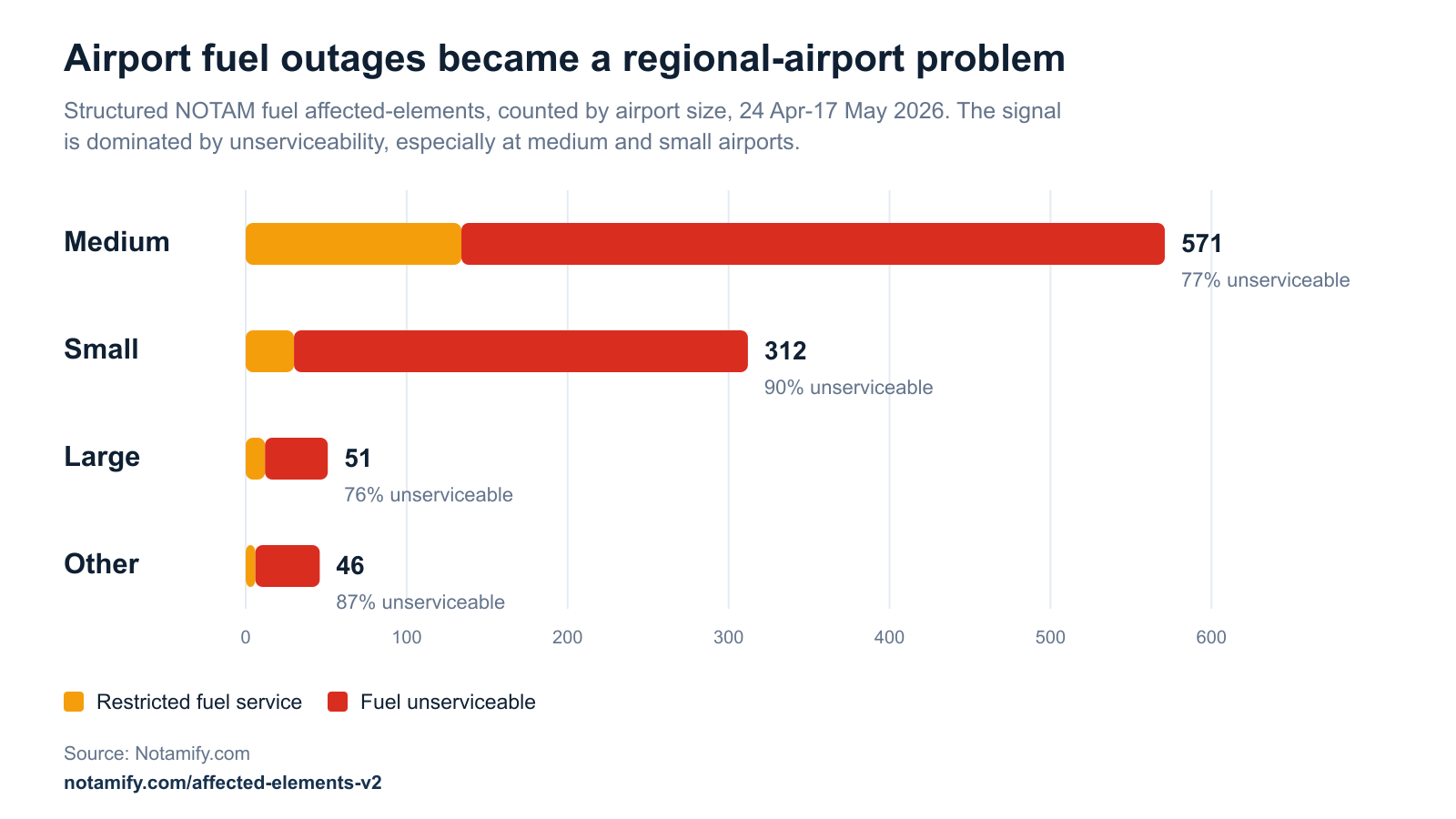
Medium airports show the largest visible burden: 571 exposures across 208 airports. Large airports show far fewer fuel NOTAM exposures in this extract, with 51 exposures across 21 airports.
There are a few plausible operational reasons for that pattern:
- large hubs may have stronger inventory buffers
- major airports may be prioritized in supply allocation
- regional airports may have fewer fallback suppliers or delivery options
- NOTAM publication practices may surface local fuel outages more visibly at smaller stations
The important point is not that large airports are immune. They are not. The point is that the NOTAM layer shows where the operational edge appears: fuel constraints are being exposed across the regional airport network.
Jet fuel: conservative count
Jet-fuel exposures accounted for 154 records across 113 airports. Of those records, 125 were unserviceable.
That is already meaningful, but it should be read as a lower-bound signal. Another 269 fuel-service exposures had no structured fuel type. Some of those may include jet fuel availability, but the data does not identify the fuel type explicitly, so we left them as unspecified instead of guessing.
This is where structured affected elements help. They let us be precise about what the data proves, and equally precise about what it does not prove.
How this connects to the Iran War fuel shock
The external aviation-fuel story is well documented.
IATA Economics described the Middle East conflict escalation on 28 February 2026 as a disruption to global energy flows and highlighted jet-fuel security vulnerabilities around the Strait of Hormuz.
Reuters reported airlines grounding aircraft, warning of fuel shortages, adding surcharges, and cutting routes as supply pressure intensified.
AP reported that EU officials could not rule out a longer-term jet-fuel shortage, with outcomes tied to the Iran War and the Strait of Hormuz.
Al Jazeera, citing AP and Reuters, reported Lufthansa's plan to remove 20,000 short-haul flights through October to save fuel.
Le Monde reported emergency European moves around Jet A as an alternative to Jet A-1, which is exactly the kind of fuel-type distinction that matters operationally.
The NOTAM data connects that macro story to field-level status. It shows where fuel service is actually being restricted or marked unavailable.
Why Affected Elements V2 made this possible
This analysis was possible because Notamify Affected Elements V2 turns raw NOTAM text into operational objects that can be reviewed, filtered, and counted.
For fuel NOTAMs, that means we can separate service state, fuel context when it is published, and the airport object the notice applies to. That is the difference between reading NOTAMs and analyzing NOTAMs.
It also means the system is not just grouping NOTAMs by Q-code. The useful layer is the operational meaning attached to the notice.
If you operate across multiple airports, you can use the same structured layer inside the Notamify Operating System to build your own NOTAM dashboards and monitor fuel, runway, lighting, navigation, and airport-service issues across your network.
The same structured layer also powers Notamify Profiles, so teams can filter NOTAMs by the operation they are actually flying and keep irrelevant fuel restrictions out of the way.
Bottom line
The Iran War fuel shock is visible in NOTAMs as airport-level fuel-service unserviceability.
The clearest operational signal is concentrated at medium and small airports, where fuel constraints appear most visibly in the structured affected elements. Jet-fuel impact spans more than one hundred airports, and the true operational exposure may be higher because many fuel-service records do not specify fuel type.
For flight operations teams, the takeaway is simple: fuel resilience is no longer only a procurement or pricing question. It is a live airport-monitoring question.
Explore Affected Elements V2
Build your own NOTAM dashboard
Filter NOTAMs by operation profile

Read more...
Track Starship NOTAMs and Restrictions
9/27/2026
Explore Starship launch restrictions, route closures and re-entry NOTAMs on one map, with notices grouped by airport and flight information region.
Faster Flight Briefings and Automatic Airport Summaries
9/25/2026
Flight briefings now generate 47% faster with improved accuracy. Airport summaries take around few seconds, with a new Auto option for airport pages.
4 Million NOTAMs: What Happens After an Airport Closes
9/12/2026
A review of airport closures, changing airspace restrictions and the information available to flight operations teams in Notamify’s archives.
NOTAM App for Pilots on iPhone and iPad
7/24/2026
Notamify is a NOTAM app for iPhone and iPad with clear interpretations, runway and taxiway maps, flight briefings, offline access, and swipe review.